Today I rode a bicycle for the first time in more than five years. The last time I remember riding a bike was sophomore year of high school, when I was a shy teenager who wanted to be a writer. Since then, I've learned to drive, applied to college, and accepted two internships in science communication. In other words, a lot has changed.
But that's not supposed to matter. As the old adage states, "it's like riding a bike." You don't forget how to do an essential life skill. At least that's what people kept telling me today: my roommate, as I retreated indoors after spending 20 minutes trying and failing to mount the bike outside our temporary Cape Cod home; my neighbor, as I walked the bike down the street to give it yet another go and she politely asked, "are you having some trouble with that?"; and my boyfriend, who should know better, as I later confessed over the phone the trouble I was in fact having. "It's like riding a bike," they all said. It was supposed to be comforting, I think.
That phrase has never really meant much to me.
I was a competitive gymnast for almost 10 years, and by far the biggest factor that caused me to stop competing was fear. If you haven't heard, gymnastics is scary. A lot of it involves throwing yourself backwards and hoping your hands and feet find the ground before your head does. But if you persevere through the fear, it can be a truly spectacular experience. And though the moves get scarier as you work your way up, they also become more exciting.
The problem I had was that I would learn how to do a cool skill, and then I would lose it. I'd forget how, or I'd stop believing that I knew how to do it. The back handspring on the balance beam, for instance, was the bane of my existence. I've done that move thousands of times, but I've spent even more time standing atop the beam, frozen in place, not unable but simply unwilling to make the jump backwards.
Many days at practice, after I'd spent hours alternating between standing frozen on the beam and crying, my patient but exhausted coach would say something along the lines of, "it's like riding a bike." As in, you just did this move yesterday. There's no reason you can't do it again.
This attempt at morale boosting was ironic for two reasons. 1) I didn't even know how to ride a bike at that point (yes, it's true, I didn't learn how to ride a bike until age 12 - thanks Mom and Dad), and 2) all the evidence pointed to the fact that I could forget how to do things. Even if we pretend that riding a bike is easy and you can never forget how, neither of which I really believe, that didn't apply to my experience with gymnastics.
When I was 12 years old, I stopped gymnastics because I, along with many of the people that cared about me, was tired of the constant mental tug-of-war. I was tired of learning new skills and forgetting how. I was tired of being scared. I wanted to try something easier - maybe something like riding a bike, which I'd heard so many good things about.
Though my time in gymnastics is long past, I never really escaped that feeling. Since then, I've seen numerous echoes of my experience with gymnastics in my everyday life. I forget how to do things and lose confidence in myself all the time. Sure, I'm not going to forget how to tie my shoes or make macaroni or whatever. But I've learned that many things, no matter how many times I do them, can still be scary.
Conducting interviews, a fundamental skill in journalism, is like that. In my classes and internships, I've had to make dozens of calls to experts and have approached plenty of people in the street to ask questions. Yes, it has gotten easier over time, but it hasn't stopped being scary. I don't think I'll ever feel completely comfortable making cold calls - I doubt any journalist ever really does. But I do hone my skills a little bit every time.
My current job is to write stories about the science that's happening at Woods Hole Oceanographic Institution (WHOI) in Cape Cod. This position, I've discovered, involves incremental blocks of time spent reporting and interviewing multiple people, followed by hours of solitary writing. Both of those activities have their scary parts. Once I get through the hullaballoo of putting myself out there and asking questions, I feel relieved. But when I sit down at my computer to write the story, I always have a moment of paralysis where I'm worried I forgot how, or I won't be able to do it this time. It's in my nature to doubt myself. My editor tells me that feeling eases with experience, but also that it never completely goes away.
Being a science writer is not like riding a bike. It's a lot more like the back handspring on beam. It's like being afraid to jump backwards, and hopefully doing it anyway. And I think that analogy also applies more generally to being an adult.
Today, I spent a humiliating hour and a half pedaling laboriously up and down my street and trying to catch myself from falling. I don't really remember how to ride a bike - though I do remember now that I was never very good at it, and that I find it kind of scary. But by the end of the day, I was biking around the neighborhood with at least some degree of confidence. I even found my way to the beach, despite my notoriously poor sense of direction.
It was fun. I'll do it again tomorrow. But it'll probably still be a little scary.
Saturday, April 23, 2016

Wednesday, January 13, 2016
Fun Facts About Aquaculture
Is it embarrassing to pick up a blog I haven't used for 15 months? I'm going to go with no. While a lot has changed since I last posted on here - I spent a year as editor in chief of NUScience Magazine, reached the halfway point of my undergraduate education, and spent six months working full time in the Corporate Communications department at Vertex Pharmaceuticals - my end goal hasn't really wavered at all. I'm still excited about becoming a science journalist, and am pursuing any and all opportunities I can to further that dream.
For the next six months or so, that pursuit will take the form of an internship at the Woods Hole Oceanographic Institution (WHOI, pronounced "who-y"). I'll be living in Cape Cod and working full time as a Science Writing Intern in the communications department of this incredible research institution. The first couple of days have been pretty quiet, but I've already started to dive in to the world of oceanography and marine science.
From what I've seen so far, both the researchers and communicators here already have a grasp on what I prioritize most in science writing, which is presenting complex information in a clear and interesting way. On my first day, I attended a meeting entitled, "Challenges and Opportunities for Robotics and Automation Applied to Aquaculture." Other than the extended essay I wrote in high school that focused on the pros and cons of genetically modified salmon, aquaculture is a topic that before Monday, I knew little about, and my knowledge of automative technology was even more poor. I was pleased and surprised to find that the information that was presented in a way that even someone who had minimal knowledge of the basic concepts could understand. Just for fun, here are a few of the cool facts I learned about aquaculture during my half-day immersion:
For the next six months or so, that pursuit will take the form of an internship at the Woods Hole Oceanographic Institution (WHOI, pronounced "who-y"). I'll be living in Cape Cod and working full time as a Science Writing Intern in the communications department of this incredible research institution. The first couple of days have been pretty quiet, but I've already started to dive in to the world of oceanography and marine science.
From what I've seen so far, both the researchers and communicators here already have a grasp on what I prioritize most in science writing, which is presenting complex information in a clear and interesting way. On my first day, I attended a meeting entitled, "Challenges and Opportunities for Robotics and Automation Applied to Aquaculture." Other than the extended essay I wrote in high school that focused on the pros and cons of genetically modified salmon, aquaculture is a topic that before Monday, I knew little about, and my knowledge of automative technology was even more poor. I was pleased and surprised to find that the information that was presented in a way that even someone who had minimal knowledge of the basic concepts could understand. Just for fun, here are a few of the cool facts I learned about aquaculture during my half-day immersion:
- Aquaculture is one potential solution to the population problem. The world population may exceed nine billion before the year 2050, and humans may consume at least 40 million tons of seafood per year by that point. Much of our fish is farmed already, but the aquaculture industry is likely to expand to meet that growing need.
- Fish farming is one of the most environmentally efficient ways to make animal protein. This means that concerns over increased greenhouse gas emissions may steer us toward more aquaculture in the future.
 |
| This graph shows the efficiency of farming fish compared to other animal protein (figure courtesy of globalaginvesting.com). |
- Most of the population views seafood as healthy but expensive. As a result, seafood is purchased more often when people are feeling wealthy, but people gravitate toward cheaper options of chicken and steak when they feel they can't fund a seafood diet. Currently, human seafood consumption is increasing.
- Most aquaculture today is done close to shore, but there are plenty of advantages to open ocean fish farming, including better water quality. However, logistical problems and a rougher environment have prevented major expansion of open ocean aquaculture thus far.
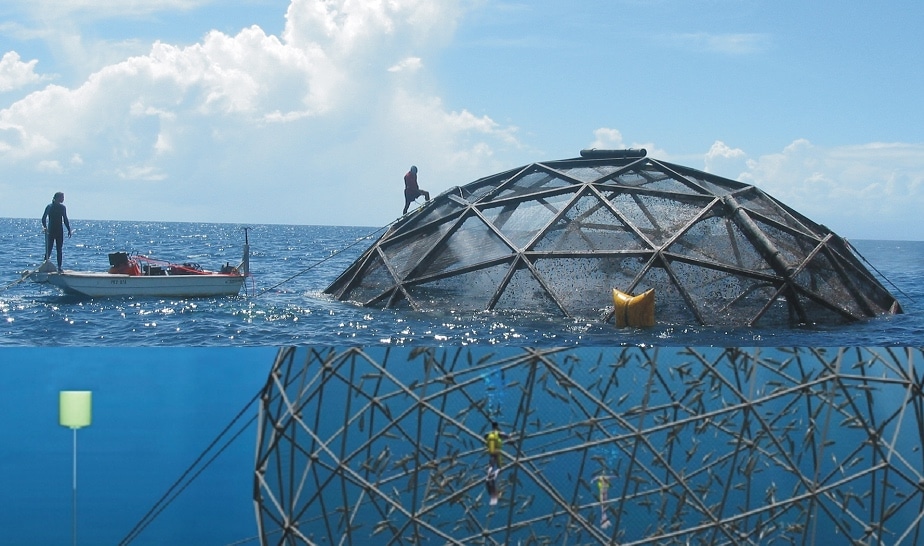 |
| An example of what an open water fish farm - this one is known as the Aquapod - looks like (image courtesy of atlasofthefuture.org). |
- Innovation in robotics technology may provide a solution for the above problem. Automation is already used for activities like feeding and cleaning, but as the technology develops, the possibilities for improvement are essentially endless. The use of Remote Operated Vehicles (ROVs) and Autonomous Underwater Vehicles (AUVs) could allow aquaculture technology to expand significantly.
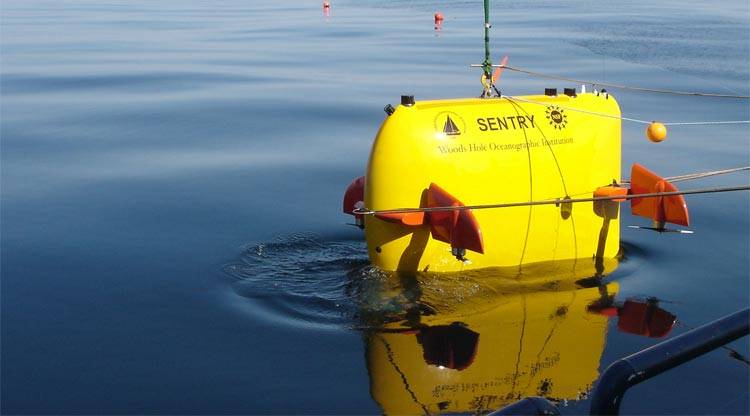 |
| An example of an AUV used at WHOI (image courtesy of Chris German). |
- While salmon/cod aquaculture is accomplished through large cages or enclosures, mussels are captured solely through the use of frayed ropes. The mussels stick to the ropes and are later placed inside mesh tubes - sort of like a cotton sock. The sock eventually disintegrates in the water, and within a couple of years, the mussels are ready for harvesting.
 |
| An example of mussel farming - the mesh covering is the "cotton sock" referred to above (image courtesy of romplastica.net). |
- The biggest threat for mussel farmers is predation from ducks, who approach the ropes and can swallow the mussels whole. Automative technology that involves a combination of light and sound is being explored to scare the ducks away from their prey.
 |
| This duck has a mouthful of zebra mussels (image courtesy of David Stimac)! |
- Robotics technology is also used to target harmful algal blooms (HABs), which are the main cause of many forms of shellfish poisoning. Forecasting technology allows researchers to track the distribution of the resting cysts that lead to contamination in sensitive areas.
I'm amazed by how much I learned in just one day, and overwhelmed by the variety of science that goes on here. Good thing I have six months to take it all in. Here's to a few great months of reading writing, and learning in an exciting new place.
Sources for this article: Presentations by Hauke Kite-Powell, David Kelly, Scott Lindell, Dana Yoerger, and Donald Anderson. See above for image sources.
Thursday, September 4, 2014
Back to Busy-ness
After four months of living at home, I am finally back in Boston for the fall semester. I can hardly believe it! Actually, it was the lead-up that was so confusing; now that I've been here about a week, I'm pretty sure I believe it. Being at college in the city - surrounded by people, schoolwork, and various modes of transportation - is a completely different experience than being at home, and I was definitely nervous about the transition (in fact, a part of me wished my already-long summer could have just kept going). However, now that I'm going to new classes, living in a great apartment with my friends, and trying out more Boston restaurants, I remember why I picked this lifestyle.
When I'm away at school, life moves faster, people talk more quickly, and it seems like there's always some activity I should or could be doing. All of that's kind of exhausting, but it's also completely ideal. If my weeks weren't chock-full of 8am classes and science magazine meetings and ever-looming exam dates, it would be pretty difficult to move forward and to become a more skilled writer, a stronger leader, and in general a more organized, successful individual.
I've realized that the part of me that wants to go to The University of Sitting on the Couch With My Cat doesn't quite jive with the part of me that wants to pursue a career as a science journalist. And I've realized that once I tap into the latter personae, I actually like doing homework, sending emails and going to meetings. As a college student, I'm supposed to be busy, and I thrive on it. That doesn't mean I won't still take time to sit on the couch (albeit without my cat) but I'm ready to be back at Northeastern, and I'm excited for what's in store.
When I'm away at school, life moves faster, people talk more quickly, and it seems like there's always some activity I should or could be doing. All of that's kind of exhausting, but it's also completely ideal. If my weeks weren't chock-full of 8am classes and science magazine meetings and ever-looming exam dates, it would be pretty difficult to move forward and to become a more skilled writer, a stronger leader, and in general a more organized, successful individual.
I've realized that the part of me that wants to go to The University of Sitting on the Couch With My Cat doesn't quite jive with the part of me that wants to pursue a career as a science journalist. And I've realized that once I tap into the latter personae, I actually like doing homework, sending emails and going to meetings. As a college student, I'm supposed to be busy, and I thrive on it. That doesn't mean I won't still take time to sit on the couch (albeit without my cat) but I'm ready to be back at Northeastern, and I'm excited for what's in store.
Friday, July 11, 2014
The Science of Serving
So far this summer, I've worked on my blog, created a LinkedIn, and watched plenty of new movies with family and friends. I've also been waiting tables at a small café about 20 miles from my house, a summer activity that's taken up a large part of my time lately - I've worked the past 8 days in a row. With all the time I've spent making small talk with strangers and writing down breakfast and lunch orders, I thought it would be fun to write a blog post that combined my summer job with my long-term career aspiration: science writing.
Working at a restaurant, especially one that includes a gelato shop and coffee station, requires me to keep a lot of different people and things in my head at one time, and it's easy to get confused. However, as I've worked longer hours and more time at the restaurant, I've found it easier to memorize orders and keep everything straight. By now I can make a latte, brew a new pot of coffee, scoop and ring up two ice creams and take out a table's order within a 10-minute time span. Some of the café's more experienced servers can move even more quickly than I can, and it occurred to me that becoming a skilled server might involve training or rewiring your brain in some way, which would make for a great blog topic.
So I looked it up, and found nothing. Surprisingly - or maybe not that surprisingly - no one seems to have done a study on how servers' brains work (i.e. how they memorize orders and juggle all the different aspects of restaurant function at the same time). I think "The Science of Serving" sounds like a great idea for either an investigative article or a scientific study, but it doesn't seem to have happened yet. I can't explain how my brain is different as a result of working in a restaurant, but I know I've managed to train myself to work more than a week in a row without complete exhaustion. The scientific links to serving aren't as obvious as the links to say, cooking, but I do think there's something to the idea.
When I wrote my first blog post for NUScience, I had trouble coming up with an topic. The blog manager told me that everything is science on some level, so I could write about whatever I wanted. My post ended up being about music therapy, but with that logic, I could have just as easily written about the science of being a server. If I can take an order, scoop gelato and brew coffee all at the same time, then couldn't I be a server, a journalist and a scientist at the same time too? That kind of combination is easier said than done, but I'm certainly doing my best.
Working at a restaurant, especially one that includes a gelato shop and coffee station, requires me to keep a lot of different people and things in my head at one time, and it's easy to get confused. However, as I've worked longer hours and more time at the restaurant, I've found it easier to memorize orders and keep everything straight. By now I can make a latte, brew a new pot of coffee, scoop and ring up two ice creams and take out a table's order within a 10-minute time span. Some of the café's more experienced servers can move even more quickly than I can, and it occurred to me that becoming a skilled server might involve training or rewiring your brain in some way, which would make for a great blog topic.
So I looked it up, and found nothing. Surprisingly - or maybe not that surprisingly - no one seems to have done a study on how servers' brains work (i.e. how they memorize orders and juggle all the different aspects of restaurant function at the same time). I think "The Science of Serving" sounds like a great idea for either an investigative article or a scientific study, but it doesn't seem to have happened yet. I can't explain how my brain is different as a result of working in a restaurant, but I know I've managed to train myself to work more than a week in a row without complete exhaustion. The scientific links to serving aren't as obvious as the links to say, cooking, but I do think there's something to the idea.
When I wrote my first blog post for NUScience, I had trouble coming up with an topic. The blog manager told me that everything is science on some level, so I could write about whatever I wanted. My post ended up being about music therapy, but with that logic, I could have just as easily written about the science of being a server. If I can take an order, scoop gelato and brew coffee all at the same time, then couldn't I be a server, a journalist and a scientist at the same time too? That kind of combination is easier said than done, but I'm certainly doing my best.
Tuesday, June 17, 2014
Why Word Count is the Bane of My Existence
Since elementary school, I've embraced all kinds of writing - journal prompts, stories, persuasive essays, and the like. I don't think I've ever gotten a writing assignment that I haven't wanted to do, and most of the time I enjoy all parts of the writing process: drafting, editing, and turning in the final product. I've always felt confident in my writing skills; however, I'll admit that I'm one of those people who just can't stick to the word count. No matter how scattered I think my idea is, I never fail to write more words than needed, whether that number is 100 or 1,000.
Estimating very roughly, I'd say that I've written about 3,000 papers in my life, a number I'm sure will grow exponentially as my college career continues. If I write an average of 500 extra words for each essay, that means I've written 1,500,000 unnecessary words in my lifetime, or 3,000 pages. Considering the couple of hours it takes to cut down a 3,000 word monstrosity to a more respectable 2,000 word piece, I imagine I could save myself weeks of time if I could quit writing when I hit the word count. But I can't seem to stop myself from going over. I've always got more to say. Like, I can't help but write too many sentences. I always have one more thing to add.
There are two factors at work here. First, I have the common problem of trying to squeeze too many words into one sentence or paragraph, which any reader of this blog has probably noticed already. Run-on sentences are easy enough to shorten during a rewrite, but I have more trouble cutting out whole sentences or paragraphs, a necessary step when I'm more than 50 words over where I should be. I tend to get attached to my ideas, and so have to seek out an objective editor to suggest where to cut down. I always manage to get to the word or page count that was assigned, but I can't help but think my life would be easier without the extra work.
Still, the wordy, sometimes rambling tone of my first drafts is a part of my writing process, and I'm not sure that it's bad for my career. I like to get all my thoughts out on paper before I think about the word count, and although it might take some extra time to get each paragraph just right, I know that I will get to the heart of what I want to say. And it's a known fact that too much material is better than not enough.
That being said, especially in journalism, I need to know how to be concise. Paragraphs in news articles are often only two sentences, and the pieces themselves rarely run more than a couple of pages. After spending high school crafting 8-sentence paragraphs and 10-page papers, learning to write like a journalist was something of a struggle for me. By taking Journalism 1, reading news websites and writing articles for the campus newspaper, I'm made significant progress in my ability to write succinctly. I'm sure my first drafts will always run an extra page and that my blog posts will often be a paragraph longer than I intended, but I'm pretty confident I can conquer my fear of the word count.
Estimating very roughly, I'd say that I've written about 3,000 papers in my life, a number I'm sure will grow exponentially as my college career continues. If I write an average of 500 extra words for each essay, that means I've written 1,500,000 unnecessary words in my lifetime, or 3,000 pages. Considering the couple of hours it takes to cut down a 3,000 word monstrosity to a more respectable 2,000 word piece, I imagine I could save myself weeks of time if I could quit writing when I hit the word count. But I can't seem to stop myself from going over. I've always got more to say. Like, I can't help but write too many sentences. I always have one more thing to add.
There are two factors at work here. First, I have the common problem of trying to squeeze too many words into one sentence or paragraph, which any reader of this blog has probably noticed already. Run-on sentences are easy enough to shorten during a rewrite, but I have more trouble cutting out whole sentences or paragraphs, a necessary step when I'm more than 50 words over where I should be. I tend to get attached to my ideas, and so have to seek out an objective editor to suggest where to cut down. I always manage to get to the word or page count that was assigned, but I can't help but think my life would be easier without the extra work.
Still, the wordy, sometimes rambling tone of my first drafts is a part of my writing process, and I'm not sure that it's bad for my career. I like to get all my thoughts out on paper before I think about the word count, and although it might take some extra time to get each paragraph just right, I know that I will get to the heart of what I want to say. And it's a known fact that too much material is better than not enough.
That being said, especially in journalism, I need to know how to be concise. Paragraphs in news articles are often only two sentences, and the pieces themselves rarely run more than a couple of pages. After spending high school crafting 8-sentence paragraphs and 10-page papers, learning to write like a journalist was something of a struggle for me. By taking Journalism 1, reading news websites and writing articles for the campus newspaper, I'm made significant progress in my ability to write succinctly. I'm sure my first drafts will always run an extra page and that my blog posts will often be a paragraph longer than I intended, but I'm pretty confident I can conquer my fear of the word count.
Friday, June 6, 2014
A Big Step, But What's Next?
About a week ago, I experienced arguably one the most important breakthroughs in my college career so far - I had a piece published on Northeastern's iNSolution blog, run by none other than Angela Herring. The article featured my friend Dan Humphrey and his work in the James Monaghan research lab, where the researchers explore the regenerative abilities of axolotl salamanders. I'd been working on the article since mid-March - well, actually, I'd been thinking about it since I interviewed Angela in February and asked if I could write for her - but in March, I went to interview Dan at the lab and began work on a first draft.
After I sent in my draft, I stopped worrying about the article for a while and instead focused on my classes, which were drawing to a close. Later, Angela sent the article back to me with some edits, but I barely was able to give them a once-over before it was time to take my final exams and head home for the summer. I sent in my revised draft in mid-May without high expectations - since the summer semester at Northeastern had already started, I figured my piece wouldn't be relevant anymore, but I hoped to at least get some feedback.
For that reason, I was surprised and delighted when Angela wrote back a couple of weeks later saying she was ready to post the new version of the article later that day. By the time I got home from working at my waitressing job, she'd put the piece up on iNSolution, complete with a very flattering bio and a link to this blog. I was extremely excited and proud of my accomplishment, as were all of the family and friends I relayed the news to.
Having my work published on iNSolution makes me feel like I'm on my way to becoming a legitimate science writer, which, coincidentally, is how I referred to Angela back in February. However, it also makes me realize that I have a lot more work to do before I can really become "legit." For one thing, I've yet to establish a routine where I post on this blog regularly, nor do I have a strong online presence on other outlets. In addition to having my article mentioned in the daily "News at Northeastern" email, the iNSolution blog post was also mentioned on Twitter. Anyone who clicked on the link to my Twitter account would have seen that I only use it to follow celebrities and other interesting people, when I could be using it to self-promote.
So I think that's my next step: move forward with my blog and my online profile, and in general learn more about what it means to be a "legit" science journalist. Angela has invited me to cover student research more often starting in the fall, another development I'm very excited about. By that time, I hope to have built my online presence enough so that if and when I get mentioned again - whether it's on the research blog, in the daily university email, or on Twitter - I'll be ready.
After I sent in my draft, I stopped worrying about the article for a while and instead focused on my classes, which were drawing to a close. Later, Angela sent the article back to me with some edits, but I barely was able to give them a once-over before it was time to take my final exams and head home for the summer. I sent in my revised draft in mid-May without high expectations - since the summer semester at Northeastern had already started, I figured my piece wouldn't be relevant anymore, but I hoped to at least get some feedback.
For that reason, I was surprised and delighted when Angela wrote back a couple of weeks later saying she was ready to post the new version of the article later that day. By the time I got home from working at my waitressing job, she'd put the piece up on iNSolution, complete with a very flattering bio and a link to this blog. I was extremely excited and proud of my accomplishment, as were all of the family and friends I relayed the news to.
Having my work published on iNSolution makes me feel like I'm on my way to becoming a legitimate science writer, which, coincidentally, is how I referred to Angela back in February. However, it also makes me realize that I have a lot more work to do before I can really become "legit." For one thing, I've yet to establish a routine where I post on this blog regularly, nor do I have a strong online presence on other outlets. In addition to having my article mentioned in the daily "News at Northeastern" email, the iNSolution blog post was also mentioned on Twitter. Anyone who clicked on the link to my Twitter account would have seen that I only use it to follow celebrities and other interesting people, when I could be using it to self-promote.
So I think that's my next step: move forward with my blog and my online profile, and in general learn more about what it means to be a "legit" science journalist. Angela has invited me to cover student research more often starting in the fall, another development I'm very excited about. By that time, I hope to have built my online presence enough so that if and when I get mentioned again - whether it's on the research blog, in the daily university email, or on Twitter - I'll be ready.
Thursday, May 1, 2014
Assessing my Progress: Freshman Year
Now that I am officially done with my freshman year of college, I have a little time to sit back, relax and reflect on my experience. Throughout this year, I've worked through a many traditional college student stresses - homework, new friends, feeling like a small fish in a big pond, etc. - but I've also accomplished a lot. During the 2013-2014 school year, I've had my writing published on four different websites (Huntington News, Her Campus Northeastern, Artistry Magazine, and the NUScience blog) and in two hard copy magazines (Huntington News and NUScience).
Writing for so many different outlets has been great practice for me, since I published barely any writing in high school, and because I wasn't really familiar with the structure of a news story until now. Furthermore, writing for a variety of publications at Northeastern has helped me feel like journalism - specifically science writing - is a viable career path for me, as long as I keep sharpening my skills over the summer and continue to pursue new writing opportunities.
In addition to building my portfolio through extracurricular writing, I've also taken some great classes in both my areas of interest, which have helped me become more well versed in science and journalism. Among others, I've taken Physics, which is a field I'd previously only studied the basics of, and I've interviewed my professor about her research on the Higgs Boson; I've taken Interpreting the Day's News, which helped motivate me to actually start reading the news, as any good journalist - and human - should; and I've taken Journalism 1, which helped me build my writing skills and become more comfortable reporting.
After all the experiences I've had this year, I still can't say I'm ready for the rest of my life to begin. However, I feel more confident than I ever have about my education, my career, and my future.
Writing for so many different outlets has been great practice for me, since I published barely any writing in high school, and because I wasn't really familiar with the structure of a news story until now. Furthermore, writing for a variety of publications at Northeastern has helped me feel like journalism - specifically science writing - is a viable career path for me, as long as I keep sharpening my skills over the summer and continue to pursue new writing opportunities.
In addition to building my portfolio through extracurricular writing, I've also taken some great classes in both my areas of interest, which have helped me become more well versed in science and journalism. Among others, I've taken Physics, which is a field I'd previously only studied the basics of, and I've interviewed my professor about her research on the Higgs Boson; I've taken Interpreting the Day's News, which helped motivate me to actually start reading the news, as any good journalist - and human - should; and I've taken Journalism 1, which helped me build my writing skills and become more comfortable reporting.
After all the experiences I've had this year, I still can't say I'm ready for the rest of my life to begin. However, I feel more confident than I ever have about my education, my career, and my future.
Friday, March 7, 2014
On Interviewing a Legit Science Writer
A couple of weeks ago, I got the chance to interview the woman that has my dream job: Angela Herring, the resident science writer at Northeastern. Not only do I find it so cool that my school has its own science writer, I loved talking to Angela about her life and her job. While the article I wrote, which was posted on the NUScience blog for Northeastern's science magazine, communicates everything I learned about Angela from the interview, I want to take some time to reflect on the experience and how it affected my own science writing aspirations.
Part of the confusion I feel looking towards a career in science writing, which I talked about in my previous post, is the difficulty of intersecting the journalism and biology majors. The journalism courses I have taken so far are so clearly catered to working at a print newspaper that it's hard to imagine having any other job. However, I am most passionate about science writing, and I wish there was a way to better integrating science with journalism in my studies (other than writing for the science blog, of course). For Angela Herring, who studied English and Chemistry while she was in college, this disparity must have been even more pronounced. However, through a combination of blogging, working in a lab, internships, and pure interest, Angela Herring landed what I can only describe as my perfect job: she spends her days interviewing scientists and writing for Northeastern's iNSolution research blog, as well as for various other publications at Northeastern and beyond.
As a college freshman, I already feel pretty certain in my desire to write about science as a career, even if I'm not sure how to get where I want to go. This is quite different from Angela Herring, who only started to seriously consider science writing several years after she graduated from Bennington College. I'm not quite sure what to make of that, since I have trouble feeling comfortable thinking I'll get a good job the future, or even assuming I can follow the career path I'm interested in.
However, talking to Angela Herring has made me feel a bit better about that uncertainty. Here's someone who's always possessed the skills of a science writer, but tried out several different different paths - including creative writing, chemistry, and working in a lab - before she found a career as a science journalist. She's a confident person and a talented writer who not long ago was a confused college student, just like me. Her advice for aspiring science writers ("ask lots of questions") as well as the story of what led her to this point will stick with me as I continue to make my way through college and work towards a successful and happy future.
I hope to continue to use Angela as a resource as I move forward in my journalism and science studies, and also to write something for the iNSolution blog sometime in the near future.
Part of the confusion I feel looking towards a career in science writing, which I talked about in my previous post, is the difficulty of intersecting the journalism and biology majors. The journalism courses I have taken so far are so clearly catered to working at a print newspaper that it's hard to imagine having any other job. However, I am most passionate about science writing, and I wish there was a way to better integrating science with journalism in my studies (other than writing for the science blog, of course). For Angela Herring, who studied English and Chemistry while she was in college, this disparity must have been even more pronounced. However, through a combination of blogging, working in a lab, internships, and pure interest, Angela Herring landed what I can only describe as my perfect job: she spends her days interviewing scientists and writing for Northeastern's iNSolution research blog, as well as for various other publications at Northeastern and beyond.
As a college freshman, I already feel pretty certain in my desire to write about science as a career, even if I'm not sure how to get where I want to go. This is quite different from Angela Herring, who only started to seriously consider science writing several years after she graduated from Bennington College. I'm not quite sure what to make of that, since I have trouble feeling comfortable thinking I'll get a good job the future, or even assuming I can follow the career path I'm interested in.
However, talking to Angela Herring has made me feel a bit better about that uncertainty. Here's someone who's always possessed the skills of a science writer, but tried out several different different paths - including creative writing, chemistry, and working in a lab - before she found a career as a science journalist. She's a confident person and a talented writer who not long ago was a confused college student, just like me. Her advice for aspiring science writers ("ask lots of questions") as well as the story of what led her to this point will stick with me as I continue to make my way through college and work towards a successful and happy future.
I hope to continue to use Angela as a resource as I move forward in my journalism and science studies, and also to write something for the iNSolution blog sometime in the near future.
Friday, January 17, 2014
The Perfect Plan?
Okay, so here's my plan: I'm going to double major in journalism and biology. On the surface, it makes total sense--I can strengthen my writing skills and still develop a strong science background, and I'll get to take classes in almost all of my areas of interest. I'll get two different degrees for the price of one and be twice as ready for whatever the world throws at me. Brilliant, right?
Maybe not so much. As much as I want to strike the perfect balance between journalism and science and eventually bring the two disciplines together, sometimes they feel like polar opposites. I might become totally prepared for a career as a journalist as well as for a career as a biologist, but I might not be prepared to combine the two into a science journalism career.
Furthermore, I feel pressed for time. It seems like recently college has become less about exploring your passions and more about building a foundation for the career you want to have--the job you can hopefully get. I can't just take random science classes and random writing classes; I have to take the right ones that will fulfill the right requirements of the right major. To put it more colorfully, I feel like I need to fit all of my courses and extracurriculars into a single cardboard box of four or five years, out of which my magically successful life and career will emerge.
I know this is old news: every college student feels this way. But I suddenly get the feeling that there's no real break between now and the rest of my life, and I'm not ready for the rest of my life to start just yet. However, I wouldn't want to go back in time. I just want to stay where I am for a while--allow myself time to make a few mistakes but ultimately still fill that box up with all the right things.
Maybe not so much. As much as I want to strike the perfect balance between journalism and science and eventually bring the two disciplines together, sometimes they feel like polar opposites. I might become totally prepared for a career as a journalist as well as for a career as a biologist, but I might not be prepared to combine the two into a science journalism career.
Furthermore, I feel pressed for time. It seems like recently college has become less about exploring your passions and more about building a foundation for the career you want to have--the job you can hopefully get. I can't just take random science classes and random writing classes; I have to take the right ones that will fulfill the right requirements of the right major. To put it more colorfully, I feel like I need to fit all of my courses and extracurriculars into a single cardboard box of four or five years, out of which my magically successful life and career will emerge.
I know this is old news: every college student feels this way. But I suddenly get the feeling that there's no real break between now and the rest of my life, and I'm not ready for the rest of my life to start just yet. However, I wouldn't want to go back in time. I just want to stay where I am for a while--allow myself time to make a few mistakes but ultimately still fill that box up with all the right things.
Saturday, November 30, 2013
So Here Goes...
Sometimes it's hard to grapple with how enormous the world is. At least that's what I've discovered in the past few months. Maybe I'm just finding it hard to grapple with the fact that I went from a community of 100 curious high school students to a community of 15,000 ambitious undergrads; to put it in the most cliché terms possible, I've become a little fish in a big pond instead of a big fish in a little pond. And I find it hard to believe that I can't accept all available opportunities--that I can't enroll in an interesting-sounding class that reached capacity exactly ten minutes after registration began and that I can't attend a lecture on the Higgs-Boson because I have a lab report due the next day.
To put this in a larger, more consequential context, I'm finding it hard to handle the fact every day, people are making enormous scientific discoveries at the same time as people are dying in natural disasters while some people are watching reruns of Gossip Girl and other people are staying up until four in the morning solving a math problem they'll probably go over in class the next day. I don't know why I didn't notice this before, since it's always been the case.
High school gave me a chance to explore what I wanted to do with my life. I've always loved writing, and my Environmental Biology course helped me discover that science writing was a great path for me. But now comes the real-life part: I have to go out and do it. I have to accept the fact that there's no real break between now and the rest of my life. I actually have to read the news if I want to write about it, since it changes every single day*. I have to reach out to professors that intimidate me and I have to practice writing science articles and I have to put together schedules. And most of all, I have to believe that this is all going to come together into a future I can thrive in.
*Believe it or not, this is not something I really understood before my Interpreting the Days News class this semester.
To put this in a larger, more consequential context, I'm finding it hard to handle the fact every day, people are making enormous scientific discoveries at the same time as people are dying in natural disasters while some people are watching reruns of Gossip Girl and other people are staying up until four in the morning solving a math problem they'll probably go over in class the next day. I don't know why I didn't notice this before, since it's always been the case.
High school gave me a chance to explore what I wanted to do with my life. I've always loved writing, and my Environmental Biology course helped me discover that science writing was a great path for me. But now comes the real-life part: I have to go out and do it. I have to accept the fact that there's no real break between now and the rest of my life. I actually have to read the news if I want to write about it, since it changes every single day*. I have to reach out to professors that intimidate me and I have to practice writing science articles and I have to put together schedules. And most of all, I have to believe that this is all going to come together into a future I can thrive in.
*Believe it or not, this is not something I really understood before my Interpreting the Days News class this semester.
Subscribe to:
Posts (Atom)